Ceiling Collapse — What To Do In the Event of a Collapsed Ceiling

Frequently Asked Questions About a Ceiling Collapse

Ceiling collapses in a house can cause serious injury and damage to the room where there were ceiling failures. The Building Commission in fact reported that it had become aware of ceiling collapses particularly in homes constructed between 2005-2009. This prompted an investigation into the problem by the Building Commission .

What Causes a Ceiling Collapse?

A roof can collapse due to negligence or faulty actions. Common causes of a sudden ceiling collapse include:

  • Neglecting to perform or poorly performing routine maintenance
  • Incorrect access and use of roof space
  • Failing to treat infestations of termites or other pests
  • Not building the house to code, poor workmanship
  • Using inferior building materials, inappropriate materials
  • Failing to repair cracks, water damage, or leak issues

If you notice warning signs such as strange popping or creaking; visual cracking, including small circles or blisters (nail pops) on the ceiling; a loud cracking sound; plasterboard sheeting that may be pulling away; or sagging or dropping sections in your home, it’s important you notify your property manager right away. Don’t dismiss any of these warning signs. Also, make sure you document all of your communication; written records can help your case in the event of a catastrophe.

Can a Ceiling Collapse Kill You?

If you happen to be in a room when there is spontaneous ceiling collapse with no warning sign, you could be seriously injured or killed. Victims have reported injuries that range from minor cuts and bruises to severe trauma like broken bones, traumatic brain injury and paralysis.

How Long Does It Take to Fix a Collapsed Ceiling?

Minor repairs, such as fixing small sags or water spots, usually involve reattaching or removing and replacing patches of plaster or drywall. A professional can usually address these problems in a few hours or less.

If the entire ceiling fell or is sagging, the restoration, cleanup and replacement will take more time, typically one to three days. If the incident causes structural damage, it might take longer.

How Much Does It Cost to Repair a Collapsed Ceiling?

While the total cost of repairs depends on the composition and damage extent, the average price tag is as follows (note these prices may vary due to the rising cost of supplies and labor):

  • Fix a sagging ceiling: $250 to $1,000
  • Stop leaks or water damage: $500 to $2,500
  • Replace a ceiling: $400 to $1,000
  • Address structural damage: $2,000-$8,000

It’s possible that your landlord may be reluctant to fix “cosmetic issues” such as small water stains or water accumulation on the floor because of the cost. However, this kind of problem is usually indicative of more serious issues including black mold that could form due to roof leaks. These types of issues should always be addressed. An inspection should be conducted to determine the cause of the leaks with a report generated on how to repair the issues for your health and safety.

What Steps Should You Take After a Ceiling Failure?

If you suffer a personal injury in a ceiling collapse, seek medical attention immediately. Be prepared to keep records of your treatment. Afterward, take the following steps:

  1. Notify your landlord as soon as possible, both verbally and in writing.
  2. Take pictures of the ceiling, debris and your damaged property.
  3. Document your injuries and make a list of any damaged or destroyed belongings.
  4. Contact an attorney with experience in New York ceiling collapses.

The Law Office of Nicholas E. Tzaneteas (NTZ Law), among its numerous practice areas, specializes in collapsed ceiling cases. For example, we represented a nursing student who sustained a back injury and required surgery after being struck by a bathroom ceiling that fell on her. The case went to court and the jury found the landlord negligent for failing to repair the ceiling after it had leaked several times. The jury awarded the nurse $6,894,132 in compensation.

In another case, Mr. Tzaneteas represented a client who was injured after being struck by parts of the apartment ceiling while taking a shower. The client suffered a back injury and required spinal surgery. The jury awarded the client $2,250,000 as compensation for the injuries.

New York tenants have rights that protect their safety. If a falling ceiling caused property damage, serious injury or a fatality, contact us so that we can help. We are available to provide you with advice.

Please visit our website for more information about us and our legal services: https://ntzlaw.com/.

What Determines the payout of a Personal Injury Trial

It’s important for you to know that you are entitled to a safe work environment. Most take that for granted, but according to the Bureau of Labor Statistics, there were almost three million cases of nonfatal illnesses and injuries related to the victim’s work reported to private insurance. You also entitled to safe practices when you put yourself in the hands of trained medical professionals and yet, The National Safety Council estimates that in 2016, almost 45 million injuries and more than 160,000 preventable deaths were attributed to causes like medical malpractice. Collectively along with slip and fall and motor vehicle accidents, these injuries fall under an area of the law known as personal injury law.

Common Personal Injury Cases

While personal injury cases can cover an incredibly varied number of incidents, there are a few broad categories under which many of them can be placed. Motor vehicle accidents (PDF), for example, are perhaps the most common type of personal injury case in the United States. These accidents can be smaller accidents that end with a dented vehicle and small medical issues, and then they can be huge, multi-vehicle crashes that lead to catastrophic injury and even death. Some of the other most common types of personal injury cases include:

  • Medical Malpractice
  • Wrongful Death
  • Product Liability
  • Assault
  • Workplace Accidents

Common Personal Injury Settlements

Personal injury victims might wonder exactly how they can expect their compensation to be structured. In general, there are two categories of damages in personal injury claims – punitive and compensatory. Compensatory damages, as the name implies, are generally intended to compensate the victim for the damages that they have suffered. These damages can include things like loss of earnings, medical bills, the projected loss of future earning power, the projected cost of future medical help, household expenses. They might also cover things like mental anguish, pain and suffering, and a loss of companionship or consortium. Compensatory damages are the most common kind of settlement awarded in personal injury cases. Punitive damages are awarded specifically to punish the at-fault individual for specific kinds of behavior such as sexual assault, aggravated battery, or fraudulent behavior.

Every Case is Different

In general, the severity and type of injuries you have suffered will determine your payout, however, no two cases are the same. Due to the incredibly nuanced nature of personal injury claims, it is impossible to offer a guaranteed payout of any specific amount. With that said, experienced attorneys are able to determine whether they believe a particular personal injury claim is viable and would stand up in court.

At The Law Office of Nicholas E. Tzanetas, we’ve had years of experience in gathering evidence, researching and trying cases involving personal injury for our clients. We understand personal injury law. We’re dedicated to our clients and work hard to ensure they receive the compensation they deserve. As a result, we’ve secured millions of dollars in compensation for our clients in monetary awards that have ranged from$300,000 to $6,894,123. We have the experience you need. Contact us today at 833.689.3476 for more information.

What Should You Do If You Get Injured At Work?

If you were injured while working, you may not be sure what to do next. Who pays the medical bills? What about the time you need to take off from work – is that covered? Will my job be waiting for me while I recover? Nicholas Tzaneteas is an experienced work injury lawyer who understands that you need assurance and peace in the process and brings years of experience, knowledge and compassion to your case.

According to the U.S. Bureau of Labor Statistics, over 4,400 people were killed on the job in 2013 and more than 1 million people suffered injuries on the job that required them to take time off from work.

What are the most dangerous jobs? These are the careers that are considered higher risk and more prone to injuries:

  • Commercial and home construction workers
  • Iron and steel workers
  • Window washers
  • Factory workers
  • Carpenters
  • Electricians
  • Painters
  • Sheet rock installers
  • Bricklayers
  • Welders

These are the most common workplace accidents which result in injuries:

  • Falling from heights
  • Slip and falls
  • Caught between objects
  • Defective or dangerous equipment
  • Equipment or machinery failure

And the most common injuries are broken bones, sprains and strains, head injuries or traumatic brain injury, joint injuries, muscle and nerve damage, internal damage and bleeding, and even death.

A workplace injury occurs when there are hazardous conditions or improper safety and care taken to prevent accidents. It can be due to negligence or equipment failure, or from an unavoidable accident. Whether reasonable precautions have been taken or not, workplace injuries are covered by workers’ compensation.

Did you know that accidents that happen while an employee is commuting to or from work, or on breaks outside the workplace during the work day are all considered work-related accidents? Because of this very broad scope and definition of workplace injuries, they are the leading cause of injury in New York City.

If you have been injured during your work day, it is imperative that you contact an experienced work accident attorney because worker’s compensation adjusters work for the insurance company, not for you. You need someone that is on your side to look out for your best interests and help you get compensation for lost wages, medical bills and any rehabilitation expenses, and pain and suffering.

Did you know that New Yorkers who have been injured on the job are entitled to all medical treatments needed for any injuries while working? New York Workers Compensation medical care insurance claims can include: medical, surgical and hospital services, dental services, crutches and orthopedic devices, hearing aids, chiropractic treatment, physical therapy, nursing care, and more and prescribed medications.

New York Workers’ Compensation cases cover a variety of work injuries ranging from sprains and cuts to total or partial permanent disability. In fact, if you have permanent or partial permanent disability with restrictions for work from your injury, you may be entitled to a settlement, which can be a monetary award covering lifetime medical care options, benefits for the disability, and even vocational rehabilitation or job re-training. This is why a professional work injury lawyer familiar with New York-specific laws is so important.

So, what are the steps to take if you are hurt at work? Here is what the New York State Workers’ Compensation Board says:

  • First, make sure to get immediate medical attention. Unless it is an emergency, be aware that the health care provider must be authorized by the Workers’ Compensation Board. Make sure you alert your doctor that this is a workplace accident. Note: You can locate authorized providers on the NYWCB website. The costs of medical services, care, and treatment will be be paid for by your employer or their insurance, unless the case is disputed.
  • Notify your supervisor about the incident and resulting injury as soon as possible. You must inform your employer in writing within 30 days of the accident. If you don’t, you could lose the right to workers’ compensation benefits.
  • If there is lost time, you must fill out and mail Form C-3 to complete a claim. Mail it to the Workers’ Compensation board.
  • Follow all medical instructions to make a full and complete recovery as quickly as possible.
  • If asked or required to, get an independent medical examination.
  • If you are notified to appear in court for any case-related hearings, make sure you do so.
  • Get back to work as soon as you can.

The laws and regulations around workers’ compensation requirements change regularly, such as in 2012, when a big case was decided in appeal that affected thousands of claimants receiving partial disability payments, or in 2010, when the Workers’ Compensation Board made sweeping changes to claim procedures. So, it’s critical to hire a workplace injury attorney who is extremely familiar with the Workers’ Compensation laws in New York City.

Work accident injuries place tremendous physical, financial, and emotional stress on both the person who was injured, as well as their families. If you are injured in a New York City workplace accident or your family has lost a loved one in a work-related accident, make sure to contact an experienced personal injury attorney who has successfully handled similar cases.

OSHA’s Fatal Four Accidents

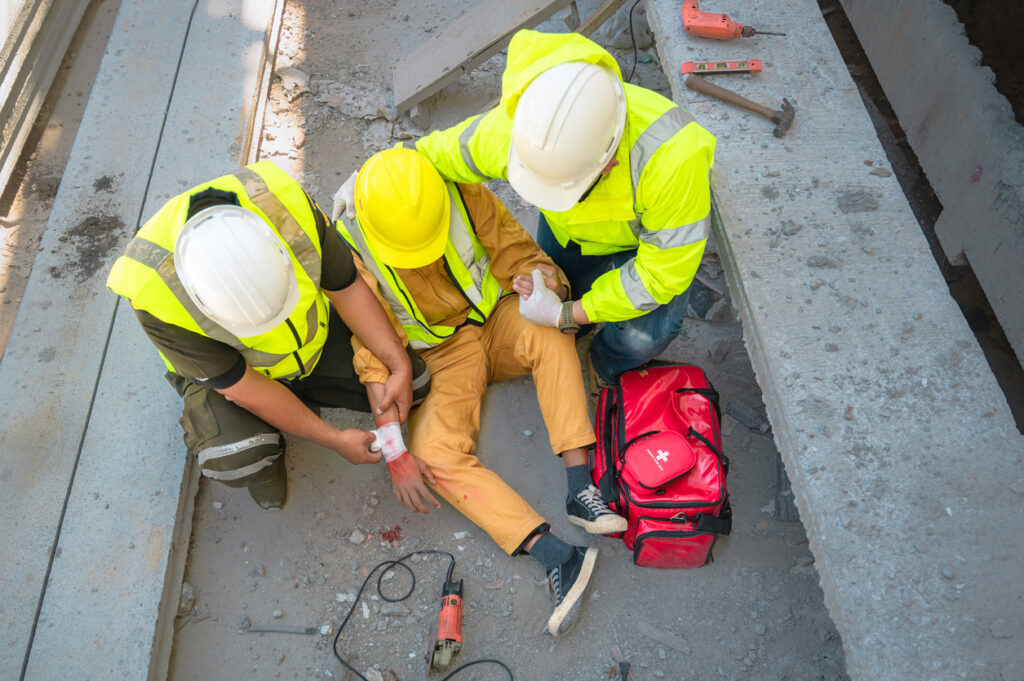
Injured While Working Construction jpg

Have you or a loved one been hurt or even fatally injured while on the job as a construction worker in New York City?

According to the U.S. Department of Labor’s Occupational Safety and Health Administration (OSHA), one in 10 construction site laborers are injured each year in serious accidents. Moreover, the Bureau of Labor Statistics (BLS) says this statistic accounts for approximately 150,000 construction site accident injuries each year.

In 2019, more than 5,300 people were fatally injured while on the job. About 20% (1,061) of worker fatalities in private industry in calendar year 2019 were in the construction sector. This accounts for one in five worker deaths for the year, according to OSHA.

NYC Construction Accident Statistics

  • Workplace fatality rates are trending upward in New York’s construction industry.
  • Non-union construction sites are especially dangerous for workers.
  • Employers who violate health and safety laws also cause worker fatalities.
  • Latino construction workers die at a disproportionate rate due to falls and employers’ “willful” violations of health and safety laws.
  • Wage and hour violators are more likely to be safety and health violators.
  • The New York City construction sector, which employs 3% of the city’s workforce, has the highest occupational death rate: 34% of all workplace deaths across various industries. For Los Angeles and Chicago, the rates are 32% and 24% respectively. The NYC sector with the next highest occupational fatality rate was the trade, transportation, and utilities industry, accounting for 20% of all workplace deaths.

Common Fatal Construction Accidents

The most common types of fatal construction accidents in the U.S., according to OSHA’s “fatal four” are:  

  • Falls
  • Being struck by an object
  • Electrocution (overhead power lines and electrical hazards)
  • Workers getting caught in/between things

These “fatal four” types of accidents are responsible for more than 64% of construction worker deaths.

Let’s take a look at the fatal four causes of construction workplace injuries.

Falls on Construction Sites

Fall hazards are the leading cause of death among construction workers. In 2019, they were responsible for 403 of the 1,061 construction fatalities. Looking at the most frequently cited OSHA standard violations for the construction industry in Fiscal Year 2020 (October 2019 – September 2020), it’s no surprise that falls accounted for nearly 38% of all construction worker fatalities.

Fall Hazards: Claims Scenarios

  • A 59-year-old construction worker fell 18 feet to his death on a site in Times Square, and a 62-year-old surveyor was on a 16th floor platform in a build on the West Side of Manhattan when it collapsed and he fell 10 stories. Both of these deaths were potentially preventable.
  • In another incident, a construction worker fell from the upper level of the Verrazano Bridge and struck a beam and broke both legs. His rescue involved cutting through a fence.
  • A contractor working on a residential building on the Upper West Side was seriously injured when he fell from a crane and required firefighters to do a difficult high-angle rescue.
  • On the Upper East Side, a laborer was working on the 6th floor of a building when he fell onto a piece of steel and had to be put in a basket and lowered six stories to the ground level for medical attention.

Proper Fall Protection

General fall protection measures include:

  • Properly training construction workers in fall protection and prevention best practices prior to beginning each job
  • Ensuring proper personal protective equipment (belts, lanyards, lifelines, fully body harnesses) is utilized

Being Struck By Objects

Anything can fall and injure other workers including tools, rolling objects, vehicle or equipment strikes, and people themselves. According to the Bureau of Labor Statistics, there are more than 50,000 “struck by falling object” OSHA-recorded incidents every year in the U.S. That equals more than one injury caused by a dropped object every 10 minutes.

Proper safety equipment and following all safety protocols could prevent thousands of falling objects. Most construction sites have fall protections in place for workers, including harnesses and being tied off, but only a few extend those protections to tools and equipment.

Electrocution

All construction workers, including bricklayers, welders, plumbers, carpenters, drywallers, and even painters are at risk of electrocution onsite. Electrical hazards include electrical sources, damaged or bare wires, and electrocution from equipment coming into contact with live overhead power lines and wires. These account for hundreds of accidents and injuries per year, including deaths.

An average of 40% of construction worker deaths from electrocution are the result of contact with overhead power lines. These power lines are very close to workers in heavy machinery like cranes, bucket trucks, scaffolds, those on ladders, and more. Workers can also be electrocuted in crawl spaces, attics, ceilings, and other areas. Electrocution can result in injuries like broken bones, brain damage, nerve damage, heart attacks, and even death.

In July 2017, for example, a construction worker was critically injured while working on the roof of a Midtown Manhattan skyscraper. Proper training and basic electrical safety knowledge and precautions (including how to operate portable electric tools) would be able to prevent many of these incidents.

Electrocution Protection

Protective measures for the electrocution hazards, one of the fatal four hazards in construction, include:

  • Conduct a risk assessment
  • Determine where electrical hazards are
  • Use testing equipment
  • Ensure workers are properly trained in electrical equipment
  • Utilize voltage breaker and ground fault circuit interrupters
  • Use cord protectors
  • Never work in wet conditions

Workplace Hazard: Getting Caught In or Between Things

Getting caught by objects or in between two objects is extremely dangerous, and accounts for more than 7% of construction accidents, the last of OSHA’s fatal four causes of injuries. While that may not seem like much, it adds up to about 70 annual deaths of workers who are killed when caught in or compressed by equipment or objects, and struck, caught, or crushed in a collapsing structure, equipment, or material. This often leads to very dangerous or precarious rescue attempts and can be a painful recovery with the potential for a permanent disability when the worker survives.

According to an OSHA training guide, the key factor in making a determination between a “Caught” event and a “Struck By” event is whether the impact of the object alone caused the injury. When the impact alone creates the injury, the event should be recorded as “Struck By.” When the injury is created more as a result of crushing injuries between objects, the event should be recorded as “Caught.”

Examples of Caught In/Between incidents:

  • Cave-ins (trenching).
  • Being pulled into or caught in machinery and equipment (this includes strangulation as the result of clothing caught in running machinery and equipment). 
  • Being compressed or crushed between rolling, sliding, or shifting objects such as semi-trailers and a dock wall, or between a truck frame and a hydraulic bed that is lowering.

Some of the working conditions that contribute to caught in/between hazards include:

  • Machinery that has unguarded moving parts or that is not locked out during maintenance.
  • Unprotected excavations and trenches.
  • Heavy equipment that tips over.
  • Collapsing walls during demolition.
  • Working between moving materials and immovable structures, vehicles, or equipment.

Protective Measures for Caught In/Between Incidents

  • Use properly guarded machinery.
  • When using a tool, never remove a safety guard.
  • Protect power tools and operating equipment with dangerous moving parts.
  • Don’t wear loose clothing.
  • Ensure equipment is de-energized and cannot be accidentally started. Before servicing and changing accessories such as blades, bits, and cutters, disconnect tools when not in use.
  • Before performing maintenance or repairs on a vehicle, turn it off. Lock out the power source to the equipment if at all possible. Before making repairs or when the equipment is not in use, lower or block the blades of bulldozers, scrapers, and similar equipment.
  • Always be aware of the heavy equipment around you and keep a safe distance from it.
  • Ascertain that all loads carried by the equipment are stable and secure. Keep out of the swing radius of cranes and other heavy machinery. Wear a seatbelt if necessary to avoid being thrown from a vehicle and being crushed by the vehicle if it tips over.
  • Protect yourself on excavation sites and avoid working in unprotected trenches that are 5 feet or deeper.

Labor Law in NY: Occupational Safety

New York Labor Law Section 240 (1), also known as the “Scaffold Law,” provides special rights of recovery to construction workers who are injured due to elevation injuries – i.e., falling from scaffolding. The law also covers cases by falls, as well as workers being hit by objects coming from heights. The law imposes absolute liability against the owner, general contractors and/or their agents. Liability is assumed. Source.

The Labor Law was put into place to protect workers and to hold their employers and third parties accountable for providing a safe workplace. The number of workers hurt and killed in the construction industry in New York has surged over the last several years, particularly with the building boom the City has experienced.

In addition, the rise in deaths and injuries — mostly among undocumented immigrant laborers — far exceeds the rate of new construction over the same period. It is stark evidence of the view increasingly held by safety inspectors, government officials and prosecutors, that safety measures at these job sites are woefully inadequate.

If you or someone you know has been injured in any way on a construction site, contact the experienced construction attorney at the Law Office of Nicholas E. Tzaneteas immediately. We can help you get compensation for medical bills, therapy, lost wages, pain and suffering and more.

For example, when one of our clients fell off of a ladder while working at a construction site, he had multiple knee surgeries and a surgery to his lower back.  He continued to receive treatment and is permanently disabled. After a lengthy trial a jury awarded him $6.1 million. 

Another construction client also fell off a ladder while on the job. He had multiple wrist surgeries and re-injured his lower back from a prior accident which now required surgery.  He continued to receive treatment and is permanently disabled. His case settled for $2,250,000.

Let us help you get the compensation your deserve.

What Can The Law Firm of Nicholas E. Tzaneteas Do For You?

We have won millions of dollars on behalf of our clients, and we will continue to fight for your health and safety in New York City. For almost 20 years the Law Office of  Nicholas Tzaneteas has earned a reputation of being tenacious and intelligent, and has taken on The City of New York and its municipalities, insurance companies, and corporations to make sure our clients are fairly compensated for the injuries they have sustained due to the negligence of these entities.  

In the article, we are going to discuss different types of cases, laws, and what you can do to protect yourself when it comes to construction accidents, premise liability, medical malpractice, and police brutality incidents.  

Construction Accidents

As a construction worker you are potentially in danger every time you go to work. When your daily work includes high-risk tasks like operating heavy machinery, climbing and working on temporary scaffolding, repairing weak structures and infrastructure, climbing and working from tall heights, and even sometimes working underground, you are constantly at risk of injury and even death. And if something should happen to your body, how can you continue to make a living?

When a construction worker is in an accident, or if a passer-by is injured by construction equipment or workers, you need an experienced construction accident lawyer to take your case. We can help determine if you have a case, and if so, we will fight on your behalf to make sure that all negligent parties involved cover lost wages, medical bills, physical therapy, pain and suffering and more.

New York Labor Law section 200, 240, and 241 are in place to protect construction workers, and you will want a construction accident attorney who understands those laws thoroughly.

Some ways you can be injured on the job include:

  • Falling debris
  • Collapsing ceilings
  • Falling from ladders
  • Malfunctioning or defective equipment or machinery
  • Negligence
  • Broken equipment or tools
  • Weak infrastructure
  • Operator error
  • Broken or weak scaffolding
  • Falling into improperly covered or secured openings or holes

If and when you are injured on a construction site, you should seek immediate medical attention. You should also document the scene of the accident and your injuries, and get contact information from eyewitnesses. We will take care of interfacing with the insurance companies, obtaining your medical records, interviewing the witnesses and more.

We recently won $2,250,000 for our client, who fell off a ladder while working at a construction site. He had multiple wrist surgeries and re-injured his low back from a prior accident, which then required surgery.  He continued to receive treatment, but is unfortunately permanently disabled.

Premises Liability

Premise liability refers to being injured while on someone else’s property AND it being the property owners fault, due to negligence. This most often refers to slip or trip and fall injuries, but technically includes all unsafe conditions, such as missing or broken stair rails. When you are invited onto someone’s property, you have a reasonable expectation of coming into a safe environment and not being injured.

When these accidents happen, the cases can be challenging because we need to  prove that the property owner knew of the dangerous condition or circumstance and neglected or chose not to fix it. You definitely need to speak with an experienced premises liability attorney who has pursued these claims before.

Other accidents that can be premises liability claims are injuries sustained on an amusement park ride or injuries of any kind on other private property. In order to have a case in these instances, you must have been on that property lawfully and not behaving in an unsafe manner. Examples of this include being intoxicated or doing something of your own volition, such as jumping from a roof into a pool and being injured.

Your injuries resulting from premises liability accidents may be anything from a bruise to a broken bone or even more severe. Here are two cases we recently won:

  • Our client is a 19-year-old nursing student, who sustained a severe back injury after being struck by a ceiling that fell on her while she was cleaning a bathtub. The ceiling had leaked many times before, and the landlord had been notified but failed to repair it properly. After treatment and multiple therapy visits failed to help relieve the pain, she had back surgery. A jury in Brooklyn awarded a total of $6,894,132 in compensation to our client.
  • Our client slipped and fell while working in a NYC building. As a direct result, he underwent three knee surgeries and eventually was told he could no longer work. He was awarded $800,000 to cover his surgeries and lost wages.

Medical Malpractice

Medical malpractice is defined as any act or omission by a physician or healthcare professional  that deviates from accepted norms of practice when treating a patient, and that results in an injury. Medical malpractice is a specific subset of tort law that deals with professional negligence.

Misdiagnosis or failure to diagnose major diseases is a form of malpractice and negligence, because often the sooner a disease is caught, the higher likelihood of a full recovery. Especially when reasonable tests should have been run but were not, or when a patient’s request is ignored.

Some of the most common medical malpractice cases include:

  • Failure to diagnose cancer or other serious diseases
  • Delay to treat or failure to diagnose a medical condition
  • Cerebral palsy & brain damage
  • Erb’s palsy
  • Gynecologic surgical errors and malpractice
  • Birth injuries
  • Hospital negligence
  • Emergency room errors
  • Medication errors or wrongly prescribed medications
  • Surgical errors & complications
  • Anesthesia errors

Medical malpractice is a highly technical type of law and these lawsuits can be extremely difficult to prove as there are so many medical waivers in place when physicians perform operations and procedures. If you or a loved one has been the victim of medical malpractice or think you may have been, reach out to us today. The Law Office of Nicholas Tzaneteas is very experienced in medical malpractice cases and winning fair compensation for our clients. A strong medical malpractice lawyer will understand the medical field, be able to obtain and understand medical records, find and work with expert witnesses, have strong anatomical knowledge and be very versed in medicine.

Motor Vehicle Accidents

According to data released by the New York City Police Department, over 500 collisions involving cars, taxis, and pedestrians happen every day. These numbers of NYC car accidents are pretty staggering and represent a very real threat to the safety of everyone moving around the city on a daily basis. If you find that you have been involved in an accident involving a car or taxi, Immediately focus on your health and safety and get medical attention, but then reach out to a qualified and experienced car accident attorney for assistance.

If you have been injured in any way, including cuts, bruises, broken bones, traumatic brain injury, or anything else, you could have a legitimate claim against the party at fault.

The Law Office of Nicholas E. Tzaneteas is a leading personal injury attorney with a track record of successes, both in and out of the courtroom. Mr. Tzaneteas is often called upon for some of the most challenging cases involving injury or death at the hands of others. We have won millions of dollars in verdicts and settlements on behalf of our clients. Some of our recent case highlights include:

  • $1,997,776 Verdict – our client was a 49 year-old woman who was injured in a vehicle collision with a box truck. As a result of the accident, our client received significant injuries to her neck, back, and shoulders. After seeking medical treatment – including several surgeries — and physical therapy, she still struggles with severe pain in her neck and back. At trial, the jury found the trucking company 100% responsible for the accident and injuries received, awarding our client a verdict for pain and suffering, lost wages, and medical expenses.
  • $4,300,000 Verdict – our client, a 58 year-old bus driver, was injured by a head-on collision by a motor vehicle. Our client suffered extensive injuries to her neck, back, and lower extremities. After four painful surgeries, the woman was left unable to return to work. With our help, she received compensation for her medical expenses as well as pain and suffering and lost wages.
  • $2,800,000 Settlement – another client, this time a 58 year-old woman from Brooklyn, was injured during an automobile accident. She required several surgeries to correct injuries to her lower back and knees. The case settled during trial, thanks to the experience and legal guidance of Nicholas Tzaneteas.
  • $1,953,102 Settlement – after receiving injuries to his lower back, hip, and knee in an automobile accident, our client, a 50 year-old man from Brooklyn, sought medical treatment. He underwent several surgeries, allowing him to resume work. When the case went to trial, we were able to obtain a substantial settlement after four days of testimony.

It is important to make a police report following a motor vehicle accident, as well as document any injuries. An experienced motor vehicle lawyer will help you navigate insurance companies, the legal battle, and understand your pain. We will make sure to get you the compensation you deserve, to help you with medical bills, pain and suffering, lost wages, and more.

Contact The Law Office of Nicholas E. Tzaneteas today. You deserve lawyers who will fight for you, and help you throughout the process of your lawsuit — from filing a claim to tracking down witnesses, to listening when you need to be heard. We are here to protect your basic rights as citizens to feel safe in your community.


What If I Get Injured While Working Construction?

There is a building boom going on in New York City and a recent article in the New York Times, Fatal Construction Accidents on the Rise in New York, reveals the fact that there were 8 deaths in 2015, and that number does not include all of the serious non-fatal injuries that also occur due to lack of safety measures, bad judgement, and/or faulty materials at construction sites. The writer, Matt Chaban, quotes the president of the Building Trades Employers’ Association, Louis J. Coletti as saying, “This is the second-most-dangerous job in America after mining, so you need guys who know what they are doing.”


Construction workers are put in harm’s way every day they show up to work. They are operating heavy machinery, working on temporary scaffolding, repairing weak structures, working at high elevations, and even working underground with limited light and air. No matter how strict safety regulations and rules are on a construction site, workers are putting their health and lives at risk every day. If something should happen to them, they can no longer work and make a living as a construction worker.


If you or a loved one has suffered from a serious injury while working in construction in New York City, you will need an experienced construction injury lawyer.


A case we recently won involved our client who fell off of a ladder while at work at a construction site. When he fell, he severely injured his wrist and re-injured a prior back injury. He ended up having multiple wrist surgeries and surgery to his lower back, and is now permanently disabled. We were able to settle his case for $2,250,000, which will pay for medical bills, ongoing treatment, pain and suffering, and lost wages.


Construction workers are the backbone of New York, working to repair and beautify our city at all hours and in all weather. When you are injured in a preventable accident on the construction site, you deserve to be compensated for your medical treatments and any lost wages you incur while recovering. Negligence is a serious offense, and if you are injured as a result of someone else’s recklessness, ignorance, or negligence, we are going to help you get what you deserve from the person or company responsible.


What are the most common types of on-the-job construction site accidents?

  • Falling from ladders, including defective ones.

  • Falling from or being injured on scaffolding from defective or insufficient equipment and supplies.

  • Falling through gaps in floors, unmarked or uncovered holes.

  • Failure to provide or provide adequate safety equipment and materials.

  • Injuries in, around, or from aerial lifts – very dangerous pieces of equipment!

  • Electrical accidents, such as those due to faulty wiring, failure to shut off power to areas where electricians are working, or other defective or malfunctioning equipment.

  • Accidents involving heavy machinery, such as forklifts, cranes, and more.


All those who work in the construction industry are protected from dangerous or unsafe working conditions under New York Labor Law Section 200, 240, and 241. These accidents can be a result of falling debris, falling off a ladder, or falling in unguarded openings.


According to the New York State Workers’ Compensation Board, here are the things you need to do immediately if you are injured on the job:

  • Get first aid or other medical treatment as soon as possible. The treating health care provider must be authorized by the Workers’ Compensation Board, except in an emergency situation.

  • Notify your supervisor about the injury and the way in which it occurred, as soon as possible. An injured employee is entitled  to workers’ compensation benefits.

  • Follow all of your doctor’s instructions for the fastest recovery.


In the case of filing a claim, you will also want to:

  • Take pictures of the scene of the accident and all equipment

  • Document all of your injuries

  • Obtain and keep a copy of your medical records

  • Get contact information for any eyewitnesses


There are time limitations to these claims and accident reports, and a qualified construction injury attorney will be able to help you and make sure everything is on time and within the statute of limitations, as well as work with you to deal with insurance companies, the workers’ compensation board, and your employer.


How can employers or employees prevent on-the-job construction accidents and injuries?

  • Provide safety training for all employees, in which all employees be required to participate

  • Hold frequent crew safety meetings, reiterating safety hazards and what to do if someone is injured.

  • Provide and make sure crews utilize all necessary protective clothing and gear.

  • Keep the site clean and uncluttered, preventing trips and falls and other injuries.

  • Make sure all equipment and tools are properly maintained and properly stored.

  • Prevent falls by installing fall protection systems such as guardrails, toe boards, screens, canopy structures or nets. Scaffolding can also prevent falls, but must be installed properly to make sure it is constructed well enough for the weight load, and regularly inspected.

  • Before any project starts, the site should be inspected for any unusual hazards and a risk assessment created to protect workers’ health and safety.

  • Be careful with any and all vehicles, making sure to be alert and aware of dangers, hazards, and defensive driving techniques.

  • Use all equipment in the proper way; follow directions.

  • Follow OSHA guidelines and report any dangerous working conditions.

  • NEVER EVER COME TO WORK INTOXICATED OR UNDER THE INFLUENCE OF ANY DRUG OR HAVING NOT SLEPT. BE AWARE AND ALERT AT ALL TIMES TO PREVENT DANGEROUS ACCIDENTS PUTTING YOU AND YOUR COWORKERS AT RISK.


Contact the Law Office of Nicholas Tzaneteas to speak to an experienced construction accident attorney who has had years of experience fighting for the rights and the best compensation for his clients.


Accessibility Tools
hide