Lawyers for Automobile Accidents: Your Complete Guide to Legal Representation After a Car Crash

Home » Lawyers for Automobile Accidents: Your Complete Guide to Legal Representation After a Car Crash
Table of Contents
ToggleAutomobile accident lawyers specialize in helping car accident victims recover compensation for injuries, medical bills, and property damage resulting from motor vehicle crashes. They navigate complex insurance claims, establish liability, and advocate for fair compensation through negotiation or, when necessary, litigation.
The following covers when to hire a car accident lawyer, the specific services they provide, the legal process timeline, and how to choose effective representation.
Key outcomes you’ll gain from this article:
- Understanding when legal representation is needed versus handling claims independently
- Knowledge of the types of car accident cases attorneys handle and their complexity levels
- Clear timeline of the automobile accident claims process from initial evaluation through resolution
- Practical criteria for selecting the right car accident lawyer for your specific situation
Understanding Automobile Accident Law and Legal Representation
Automobile accident law encompasses the legal framework governing liability determination, insurance claims, and compensation recovery after motor vehicle crashes. This area integrates tort law (negligence principles), insurance law (coverage requirements and claim procedures), and procedural rules (filing deadlines and court processes).
Specialized legal representation matters significantly for car accident victims because the insurance claims process is highly technical. Attorneys understand which policies apply—liability, personal injury protection, uninsured motorist coverage—and how coverage exclusions, policy limits, and statutory thresholds affect compensation. In New York, for example, only injuries meeting the statutory “serious injury” threshold under Insurance Law § 5102 allow victims to recover non-economic damages beyond no-fault benefits.
Personal Injury Claims in Automobile Accidents
Personal injury claims address bodily harm suffered in a car crash, distinct from property damage claims that focus solely on vehicle repair or replacement costs. While property damage claims typically resolve through collision coverage or the at-fault driver’s liability insurance, personal injury claims encompass ongoing medical needs, income loss, and subjective suffering that require comprehensive evaluation.
Compensation in personal injury cases includes economic damages (past and future medical expenses, lost wages, rehabilitation costs, medical equipment, and long-term care) and non-economic damages (pain and suffering, emotional distress, loss of enjoyment of life, and disfigurement). In rare cases involving egregious conduct, such as drunk driving, punitive damages may also be available.
Personal injury law forms the foundation of automobile accident legal representation because most car accident injuries require assessment of both immediate and future losses. An experienced car accident attorney evaluates the full scope of damages rather than accepting quick settlements that address only current medical bills.
Insurance Law and Liability Determination
Insurance requirements vary by state and directly affect how car accident victims seek compensation. Every state mandates minimum liability coverage, and many require additional protections like personal injury protection (PIP) or uninsured motorist coverage.
No-fault vs. fault-based systems create fundamentally different paths to recovery:
- Fault-based systems require injured parties to prove another driver’s negligence to recover economic and non-economic damages. Most U.S. states follow this approach.
- No-fault systems (including New York) require drivers to carry PIP coverage that pays their own medical bills and lost wages regardless of fault. However, lawsuits for non-economic damages are restricted unless injuries meet a statutory threshold.
New York’s Insurance Law § 5102 defines “serious injury” to include bone fractures, significant disfigurement, permanent limitation of use of a body organ or system, or injuries preventing substantially all usual daily activities for at least 90 of the 180 days following the accident. Car accident victims whose injuries don’t meet this threshold are generally limited to no-fault benefits.
Comparative negligence also affects compensation. New York applies pure comparative negligence under CPLR § 1411, meaning a plaintiff’s recovery is reduced by their percentage of fault but isn’t barred entirely—even if they’re 99% responsible. Insurance companies frequently argue shared fault to reduce payouts.
Statute of Limitations and Legal Deadlines
The statute of limitations sets the maximum time to file a car accident claim. In New York, personal injury and property damage claims arising from automobile accidents must be filed within 3 years of the crash date under CPLR § 214. Wrongful death claims have a shorter window of 2 years from the date of death.
Beyond lawsuit deadlines, accident victims face additional time-sensitive requirements:
- DMV reporting: New York requires accident reports within 10 days if property damage exceeds $1,000
- No-fault claims: Initial notice to insurers typically must be filed within 30 days
- Evidence preservation: Physical evidence, witness memories, and surveillance footage degrade quickly
These legal deadlines make immediate attorney consultation essential after a car crash. Missing a filing deadline can permanently bar recovery regardless of injury severity or the other driver’s clear fault.
Types of Automobile Accident Cases Lawyers Handle
Automobile accident lawyers handle a wide range of crash scenarios with varying levels of complexity. Each case type requires specific expertise in liability determination, evidence gathering, and damage calculation appropriate to the circumstances.
Multi-Vehicle Collisions and Complex Liability
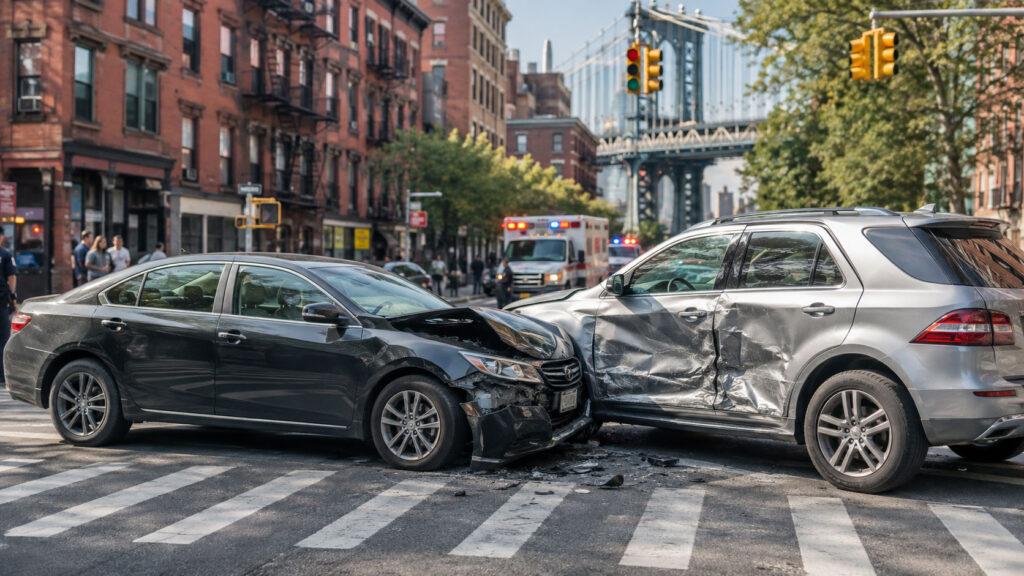
Rear-end crashes, intersection accidents, and chain-reaction collisions often involve multiple parties whose fault percentages require careful analysis. In a three-car pileup, determining whether the first impact caused subsequent collisions—or whether independent negligence by each driver contributed—significantly affects how compensation is allocated.
Multiple parties complicate fault determination because each driver’s insurance carrier advances theories minimizing their client’s responsibility. Evidence preservation becomes critical: accident scene photographs, vehicle damage patterns, skid marks, and traffic camera footage help reconstruct the collision sequence. Witness testimony establishes the timing and causation that physical evidence alone cannot prove.
Car accident lawyers handling complex liability cases frequently engage accident reconstruction experts who analyze vehicle dynamics, impact angles, and driver reaction times. These technical experts counter insurance company assertions and establish clearer fault allocations in disputed cases.
Commercial Vehicle and Truck Accidents
Auto accidents involving commercial trucks, delivery vehicles, and rideshare cars introduce additional liable parties beyond the drivers themselves. Trucking companies, vehicle owners, maintenance providers, and equipment manufacturers may share responsibility depending on the cause of the crash.
Commercial vehicle cases typically involve greater insurance exposure because federal and state regulations require higher policy limits for commercial operations. Severe injuries are more common due to the size and weight differential between trucks and passenger vehicles.
These cases build on standard collision principles but add regulatory compliance issues: hours-of-service violations, maintenance log falsification, and inadequate driver training can establish negligence beyond simple traffic law violations. An experienced auto accident attorney investigates these regulatory dimensions that individual crash victims cannot access on their own.
Impaired and Distracted Driver Cases
Drunk driving, drugged driving, and distracted driving accidents involve negligent conduct that courts treat more seriously than ordinary carelessness. When toxicology tests, cell phone records, or witness observations establish impairment, victims may recover enhanced damages reflecting the defendant’s conscious disregard for safety.
These cases often run parallel to criminal proceedings. While civil and criminal cases are separate, evidence collected for prosecution—police reports, blood alcohol results, and officer testimony—strengthens the civil claim. Punitive damages, though rare in New York auto accident cases, become more available when the defendant’s conduct demonstrates reckless indifference to others’ safety.
Driver fatigue cases present similar issues to impairment claims, particularly in commercial trucking contexts where hours-of-service regulations exist specifically to prevent fatigue-related crashes.
The Legal Process and Choosing the Right Attorney
Understanding the types of automobile accidents that attorneys handle provides context for the practical steps involved in legal representation. The claims process follows a predictable sequence, though the timeline and complexity vary based on injury severity and insurance company cooperation.
The Automobile Accident Legal Process
This process typically begins after medical stabilization, when accident victims can focus on legal matters without compromising their health recovery.
- Initial case evaluation and evidence gathering: Attorneys assess liability strength, available insurance coverage, and injury severity while collecting police reports, medical records, accident scene photographs, and witness statements.
- Insurance claim filing and negotiation: Filing no-fault (PIP) claims with your own insurer and liability claims against at-fault parties; responding to insurance adjusters and providing requested documentation.
- Medical treatment documentation and expert preparation: Continuing treatment while building comprehensive records of all medical expenses, procedures, and prognosis; securing expert testimony from treating physicians or specialists when needed.
- Settlement negotiation or lawsuit filing: Presenting demand letters, engaging in negotiation, and evaluating whether settlement offers reflect true case value; filing lawsuits when insurers refuse fair compensation or when the serious injury threshold allows broader recovery.
- Trial preparation and court representation: If a settlement cannot be reached, proceeding through discovery, depositions, motions, and trial; presenting evidence to juries and cross-examining defense witnesses.
The full process may take months for straightforward cases or years for complex litigation. Throughout, experienced car accident lawyers maintain communication with clients while handling technical legal requirements.
Comparing Attorney Fee Structures
Different payment arrangements exist for accident victims, each appropriate to different case circumstances.
Contingency fee arrangements dominate car accident representation because they align the attorney and client interests toward maximum recovery. NYC car accident law firms commonly charge approximately one-third (33.33%) of the settlement or verdict. Under contingency arrangements, clients pay nothing upfront, and attorneys collect legal fees only if they secure compensation.
Additional costs beyond attorney fees may include medical record retrieval, expert witness fees, court filing fees, and deposition expenses. Fee agreements should specify whether the firm advances these costs (deducted from settlement) or whether clients pay them separately.
Common Challenges and Solutions
Insurance companies and legal complexities create obstacles that car accident victims rarely anticipate. Understanding these challenges—and how experienced attorneys address them—helps clients set realistic expectations for their cases.
Low Settlement Offers from Insurance Companies
Initial settlement offers from insurance carriers typically cover only immediate medical costs visible at the time, ignoring long-term expenses, future medical treatment, lost earning capacity, and pain and suffering. Data from NYC practitioners indicates that initial offers often represent only 20-40% of the true case value.
Solution: Hiring an experienced car accident lawyer who understands full case valuation ensures victims don’t accept inadequate settlements. Attorneys obtain medical expert reports documenting prognosis and future care needs, calculate lifetime earnings impact, and present demand packages that establish appropriate compensation ranges.
Delayed Medical Symptoms and Documentation
Soft tissue injuries, concussions, internal injuries, and some fractures may not be immediately apparent after a car crash. Adrenaline masks pain, and some conditions worsen progressively. If injuries aren’t documented early, insurance companies argue they arose from other causes or didn’t result from the accident.
Solution: Seek medical attention immediately after any automobile accident, even when injuries seem minor. Follow up with specialists as symptoms develop, maintain detailed records of all treatment, and document non-economic effects (sleep disruption, mood changes, activity limitations). Comprehensive medical records from the accident forward create the evidentiary foundation for fair compensation.
Disputed Fault and Liability Issues
Insurance adjusters frequently assert comparative negligence to reduce payouts, claiming the victim contributed to causing the crash. In pure comparative negligence states like New York, any percentage of fault reduces recovery proportionally, giving insurers a strong incentive to shift blame.
Solution: Working with attorneys who reconstruct accidents through independent evidence-gathering counters insurance companies’ fault allegations. Traffic camera footage, dashcam recordings, event data recorders (vehicle “black boxes”), and accident reconstruction experts establish objective facts that witness testimony alone cannot prove. Understanding that New York law allows recovery even with partial fault helps victims pursue claims that insurance companies might discourage.
Contact the Law Office of Nicholas E. Tzaneteas
Automobile accident lawyers provide essential advocacy for car accident victims navigating insurance complexity and legal procedures that favor well-resourced insurers. From establishing liability through evidence gathering to negotiating settlements that reflect the true value of the case, experienced car accident attorneys protect victims’ rights throughout the recovery process.
The Law Office of Nicholas E. Tzaneteas specializes in helping car accident victims in New York City secure the compensation they deserve. With experience handling serious car accident cases, including multi-million-dollar verdicts, we provide dedicated representation for NYC automobile accident victims facing insurance companies and complex liability issues.
Additional Resources
- New York statute of limitations: Three years for personal injury and property damage claims; two years for wrongful death
- Required insurance minimums in New York: $25,000/$50,000 bodily injury liability; $10,000 property damage; PIP coverage; uninsured motorist coverage
- Serious injury threshold categories: Bone fracture, significant disfigurement, permanent limitation of use, 90/180-day disability rule
Schedule a free consultation
THE LAW OFFICES OF NICHOLAS E. TZANETEAS
-
1392 Coney Island Avenue
Brooklyn, New York 11230
-
55 Church Street, Suite 201
White Plains NY 10601